Artist Statement
Background
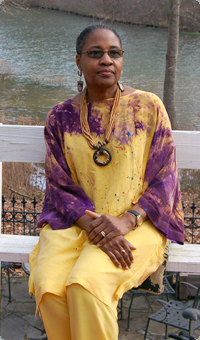
Charlotte Riley-Webb is in the midst of a convergence of
music, poetic verse and visual art as she produces her
project: Blood Rhythms, Strange Fruit. More than two
years in the making, this exhibition is based on a
Sankofa mentality: acknowledging the past to improve
our future.
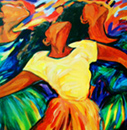
 Blood Rhythms, Strange Fruit will feature visual
interpretations of Ntozake Shange’s Blood Currents,
Blood Rhythms and Blues Stylin', and various pieces
from Nina Simone’s body of work. Poet Ntozake Shange
and songstress Nina Simone have been among the
most influential contributors to my artistic library for most
of my creative life, and from whom I continue to draw
inspiration.” said Charlotte. “When immersed in
Shange’s Blood Currents, Blood Rhythms and Blues Stylin,’ I am captivated by the
depth of artistry through which Ntozake interlaced life and history through
contemporized metaphors.” Shange’s poem was the muse for twelve of the twenty-two
paintings scheduled for the premiere of this traveling exhibition. The lyrics of Nina
Simone’s work bears a unique and little known history worthy of much discussion. Her
rendition of Strange Fruit is mirrored in Shange's poem. Adding to the depth of the
exhibition will be the contemporary voice of poet Tzynya Pinchback, who was selected
because of her unique artistic style. The visual
representations embodied in her poems
compliment the totality of this project.
Blood Rhythms, Strange Fruit will feature visual
interpretations of Ntozake Shange’s Blood Currents,
Blood Rhythms and Blues Stylin', and various pieces
from Nina Simone’s body of work. Poet Ntozake Shange
and songstress Nina Simone have been among the
most influential contributors to my artistic library for most
of my creative life, and from whom I continue to draw
inspiration.” said Charlotte. “When immersed in
Shange’s Blood Currents, Blood Rhythms and Blues Stylin,’ I am captivated by the
depth of artistry through which Ntozake interlaced life and history through
contemporized metaphors.” Shange’s poem was the muse for twelve of the twenty-two
paintings scheduled for the premiere of this traveling exhibition. The lyrics of Nina
Simone’s work bears a unique and little known history worthy of much discussion. Her
rendition of Strange Fruit is mirrored in Shange's poem. Adding to the depth of the
exhibition will be the contemporary voice of poet Tzynya Pinchback, who was selected
because of her unique artistic style. The visual
representations embodied in her poems
compliment the totality of this project.
In part, Webb’s paintings are an interpretation
of not only the words, but the relationships,
accomplishments and resilience mirrored in her
own life experiences. The resulting dialogue
should prove to be thought provoking for all
who choose to engage.
For more information about the exhibition and
project, email Charlotte Riley-Webb at cwebbart@bellsouth.net.
I admired the works of the 20th century Expressionist painters. I would occasionally explore the realm of nonrepresentational imagery in my earlier paintings. What I did not realize at the time, was that the language I needed to create this new body of work, was already embedded in the unique rhythmic strokes and style of my representational images.
The traditional definition of abstract art: Abstract art is purely non-objective and non-representational; it does not depict the reality of specific objects. At its inception, this genre's movement redefined what art is and began breaking all of the traditional rules of art. Artists began leaving out information, splattering paint, texturing the surfaces, using fewer strokes and bolder colors.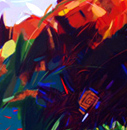 I think that it is the "rule breaking" that initiated the "conceptual" or "Abstract" art movement, creating the contrasting perspectives and inspired illusions. I depend on the wonders of nature to supply many of the patterns and designs present in my work and believe that colors, shapes and depths have their own rhythm, weight and importance in art. We can often find the story in music. Representational art is like music with words and abstraction reminiscent of "Blues blue" and "magenta Jazz". They are often based on a theme that takes on different forms or a spiritual experience. In my incorporation of as many of our senses as possible into my paintings, many often speak of the ability to hear my paintings, the rhythms that glide across the canvas, resonating in the melodic tunes embodied within the intensity of the colors, the strength of the lines and boldness of the strokes. It is a common belief that ancient African cultures feared the elements, but in fact, African peoples trust in the continuity of nature, its unchanging cycle of seasons and the succession of day and night. The symbols used to communicate messages within the living world and serve as a link to our ancestors and the supernatural world are, to the untrained eye, abstract in nature. I believe that there are many ways to tell our history. I think that it is the "rule breaking" that initiated the "conceptual" or "Abstract" art movement, creating the contrasting perspectives and inspired illusions. I depend on the wonders of nature to supply many of the patterns and designs present in my work and believe that colors, shapes and depths have their own rhythm, weight and importance in art. We can often find the story in music. Representational art is like music with words and abstraction reminiscent of "Blues blue" and "magenta Jazz". They are often based on a theme that takes on different forms or a spiritual experience. In my incorporation of as many of our senses as possible into my paintings, many often speak of the ability to hear my paintings, the rhythms that glide across the canvas, resonating in the melodic tunes embodied within the intensity of the colors, the strength of the lines and boldness of the strokes. It is a common belief that ancient African cultures feared the elements, but in fact, African peoples trust in the continuity of nature, its unchanging cycle of seasons and the succession of day and night. The symbols used to communicate messages within the living world and serve as a link to our ancestors and the supernatural world are, to the untrained eye, abstract in nature. I believe that there are many ways to tell our history.
This genre -- and its "stories" is one of them – has been around for centuries. It is interesting that the viewing public, especially those familiar with my prior works, constantly try to find the stories and recognizable imagery in my abstract paintings. They are pleased if their imagination discovers a face or an animal of sorts. What I have deduced, as an abstract artist, is that it takes an entirely different perception and an openness of the imagination to understand the work and to appreciate it on a deeper level. Because many of the stories in my "Stories" series came from complete strangers, it was the space between the story given me and the way I received it that determined the degree of realism or abstraction I incorporated into the painting. With these conceptual works, the beginning and the end of the story are the same. These paintings take a journey through my soul on the way to the canvas, where they are cultivated and materialize. I am going to ask you as the viewer to take it all in, not necessarily expecting to understand the work immediately, but to take the time to appreciate the essence, created by the textures, lines, strokes, and compositions. And in interpreting the depth of my emotional awareness as an artist, we together just might reach a new level of understanding of this abstract genre. It is after all, the language that I am currently choosing to dare broach the world of the conceptual unknown.
Always Art,
Charlotte Riley-Webb
|